Skip to content
Comparison hub for service businesses

Find the right booking stack for your growth stage

Compare booking platforms by workflow continuity, team complexity, and conversion goals.

View matrix|Set up in under 5 minutes
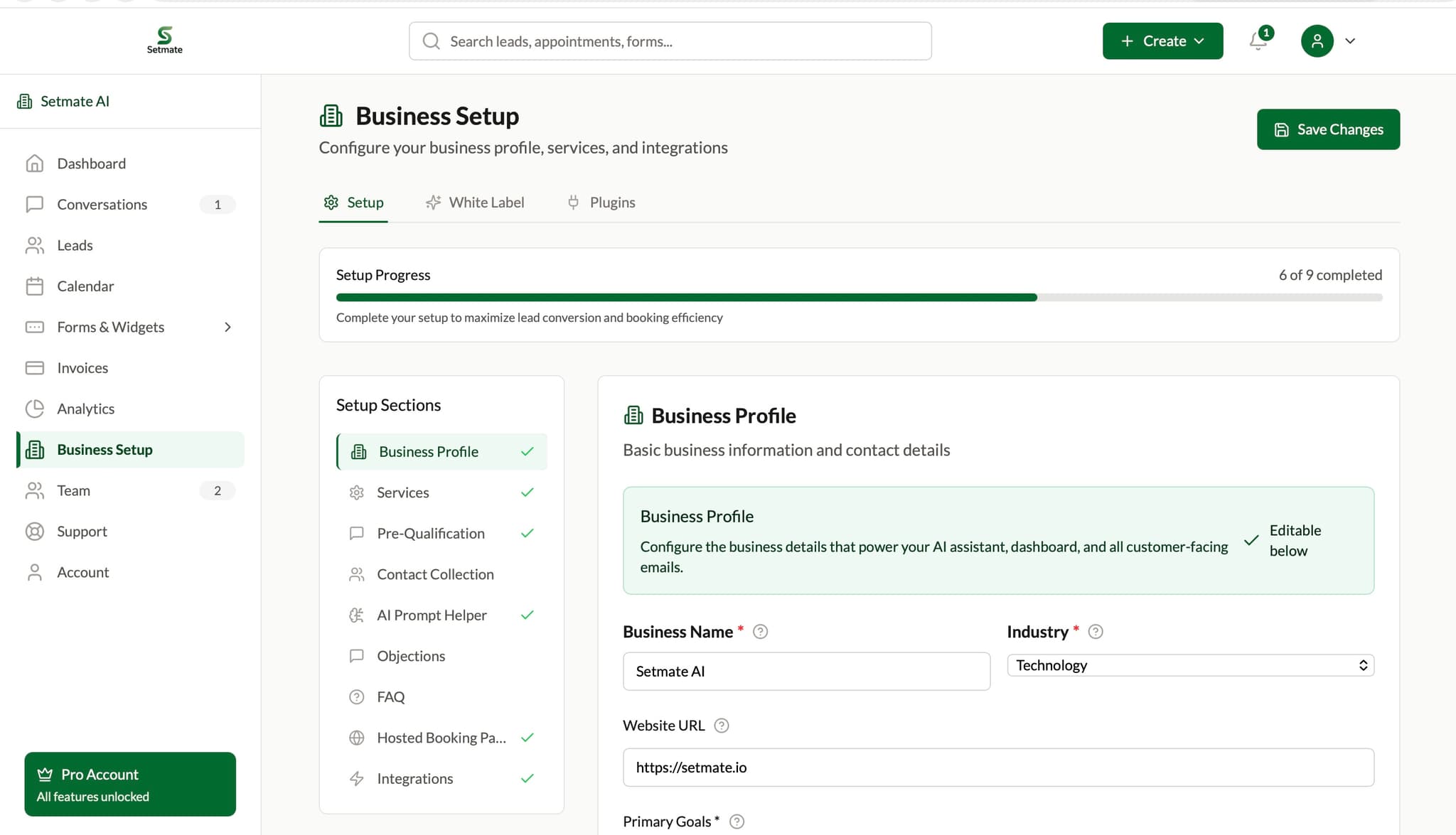
Setmate workflow dashboard preview

Scheduling tool or conversion workflow?

Most teams compare tools by calendar features alone. That misses the operational cost of fragmented handoffs across forms, schedulers, payment pages, and sync layers.

What teams usually buy

Scheduler, router, chat, and CRM sync as separate tools.

What usually breaks

More handoffs, slower follow-through, and unclear conversion leakage.

What to evaluate instead

Continuity, payment timing, and setup overhead by team stage.

Every fragmented handoff is a chance for qualified leads to drop off - and most teams never see where they lost them.

How booking journeys usually break

Two common operating models. One is fragmented and stack-heavy; the other is unified for conversion continuity.

Industry standard (fragmented)

Best for lightweight scheduling

Visitor -> Form/Chat -> Routing Tool -> Scheduler -> Payment Tool -> CRM Sync -> Accounting Sync

  • Extra handoff step risk
  • More configuration surfaces
  • Greater dependency on stack coordination

Unified conversion flow

Best for revenue continuity

Visitor -> Qualification -> Payment-aware Booking -> Confirmation -> CRM/Accounting Handoff

  • Fewer handoffs
  • Lower orchestration overhead
  • More consistent conversion path

Comparison methodology

How this comparison is scored

Classification is based on publicly documented primary product behavior. Labels are directional and may vary by plan, integration setup, and region.

Native means core and documented behavior without relying on custom stack orchestration.

Partial means add-on, plan-dependent, or integration-dependent behavior.

Not core means not central to the primary product value proposition.

Use this matrix as a shortlist filter, then validate fit in dedicated comparison pages.

Compare core capabilities at a glance

Fast scan table for buyer-critical dimensions. Use this to shortlist before deep-diving into each workflow fit.

Native/core capabilityAdd-on, partial, or plan-dependentNot core to primary product value

Setmate

Details

AI

In-flow payment

Qualification

Routing

CRM sync

Accounting sync

Setup: Low-Med · Segment: SMB service businesses

Calendly

Details

AI

In-flow payment

Qualification

Routing

CRM sync

Accounting sync

Setup: Low-Med · Segment: Individual to teams

Acuity

Details

AI

In-flow payment

Qualification

Routing

CRM sync

Accounting sync

Setup: Low-Med · Segment: Service SMBs

Chili Piper

Details

AI

In-flow payment

Qualification

Routing

CRM sync

Accounting sync

Setup: Med-High · Segment: RevOps / enterprise GTM

RevenueHero

Details

AI

In-flow payment

Qualification

Routing

CRM sync

Accounting sync

Setup: Med · Segment: B2B GTM teams

HubSpot Meetings

Details

AI

In-flow payment

Qualification

Routing

CRM sync

Accounting sync

Setup: Med · Segment: HubSpot-centric teams

Microsoft Bookings

Details

AI

In-flow payment

Qualification

Routing

CRM sync

Accounting sync

Setup: Low-Med · Segment: Microsoft ecosystem orgs

AI-native adjacent

Details

AI

In-flow payment

Qualification

Routing

CRM sync

Accounting sync

Setup: Med-High · Segment: AI SDR / pipeline teams

Capability classifications reflect primary documented product behavior and may vary by plan or integration.

Ratings are directional and intended for shortlist decisions.

Price reality check

Compare total stack cost, not line-item software cost.

Routing-heavy enterprise tooling can carry significantly higher monthly overhead for smaller teams.

Combining scheduler, qualification, and payment tooling can introduce extra cost and operational complexity.

Same workflow objective. Different stack economics.

Competitor fit by workflow context

Neutral blocks for buyer fit analysis. Each section highlights strengths, likely friction points, and where Setmate differs in service-business execution.

Calendly

calendly alternative for service businesses

Best for: Individuals and teams that need fast scheduling and routing.

Core strength: Widespread adoption, routing forms, and broad familiarity.

Where friction appears: No native payment collection before booking in every flow, and qualification often needs additional tooling.

Where Setmate differs: Combines qualification and payment-aware booking in a service-business-focused setup.

Neutral fit statement: Strong fit when your main requirement is scheduling standardization.

Acuity

acuity alternative for booking automation

Best for: Appointment-led SMBs with classic scheduler and intake form workflows.

Core strength: Service-business scheduling with payment processor options.

Where friction appears: Limited routing depth for multi-rep teams and no conversational AI qualification layer.

Where Setmate differs: Provides tighter continuity from qualification to booking and payment in one flow.

Neutral fit statement: Strong fit for straightforward appointment operations.

Chili Piper

chili piper alternative for smb service teams

Best for: RevOps teams that need advanced enterprise routing and distribution logic.

Core strength: High routing sophistication and demand conversion controls.

Where friction appears: Can include high base platform costs and often needs dedicated ops administration.

Where Setmate differs: Designed for faster SMB rollout with payment-aware booking included.

Neutral fit statement: Strong fit for complex enterprise routing environments.

RevenueHero

revenuehero alternative

Best for: B2B teams optimizing qualification, routing, and meeting operations.

Core strength: Strong inbound and outbound routing controls.

Where friction appears: Payment and accounting continuity typically rely on extra tools and GTM ownership.

Where Setmate differs: Packages booking, payment, and post-booking sync for service execution.

Neutral fit statement: Strong fit for routing-heavy GTM teams.

HubSpot Meetings

hubspot meetings alternative for service businesses

Best for: Teams already committed to HubSpot CRM-centric operations.

Core strength: Native CRM context with broad sales workflow integration.

Where friction appears: Advanced workflow controls can depend on higher-tier hubs and additional seat cost.

Where Setmate differs: Provides conversion workflow focus without requiring full CRM-suite dependency.

Neutral fit statement: Strong fit when HubSpot is your operational center.

Microsoft Bookings

microsoft bookings alternative

Best for: Microsoft 365-first organizations needing appointment scheduling.

Core strength: Convenient ecosystem alignment and bundled access.

Where friction appears: Built for appointment scheduling first, not conversion-qualified payment-aware booking.

Where Setmate differs: Emphasizes conversion continuity with payment-aware booking and handoff control.

Neutral fit statement: Strong fit for internal M365 scheduling alignment.

AI-native adjacent

ai booking software comparison

Best for: Pipeline generation and SDR automation motions.

Core strength: Conversational engagement and lead qualification signals.

Where friction appears: Often optimized for pipeline generation, not service-business payment-to-booking execution.

Where Setmate differs: Focused on service workflow execution from qualification through booking and payment.

Neutral fit statement: Strong fit in enterprise or outbound-heavy AI SDR contexts.

Choose the path that matches your team stage

Skip persona overload. Pick by current operational reality, then branch to the right evaluation depth.

1-5 people

Solo or small team

Need: Simple booking plus payment collection without operational complexity.

Recommended: Setmate or Acuity

Start free with Setmate
5-20 people

Growing team

Need: Routing, qualification, and CRM sync without enterprise overhead.

Recommended: Setmate or Calendly Teams

See Setmate pricing
20+ people

Enterprise routing

Need: Advanced distribution rules and dedicated routing ownership.

Recommended: Chili Piper or RevenueHero

Setmate can still fit simpler enterprise workflows.

Explore workflow fit first

Fit-based recommendations

If you need X, choose Y. Keep the decision practical, staged, and reversible.

If you need: You need payment before confirmed booking with minimal setup.

Choose: Start with Setmate.

If you need: You already run a scheduling-only workflow and just need meeting links.

Choose: Calendly or Acuity can be enough.

If you need: You need advanced enterprise routing ownership and distribution controls.

Choose: Chili Piper or RevenueHero are usually better suited.

If you need: You rely deeply on HubSpot or Microsoft ecosystem workflows.

Choose: Their native meeting schedulers can be the simplest operational fit.

Common objections, answered clearly

Practical guidance for migration, stack overlap, and comparison fairness.

No. Most teams start with one high-intent flow and run Setmate alongside their current stack during evaluation. That gives you side-by-side data before any bigger migration decision.

Minimal for most teams. Connect your calendar, configure one flow, and launch. You can keep your existing tooling while validating conversion impact.

You do. Data export and deletion pathways are available so your team controls portability and retention decisions.

We use publicly documented capabilities and pricing structures, then apply the same classification logic across all rows so teams can compare consistently.

Already using another tool? Switch in minutes, not months.

Keep your existing calendar integrations (Google, Outlook, iCal).

Start fresh or import your existing booking links.

Run Setmate alongside your current tool during transition.

Cancel anytime with no contracts and no lock-in.

Trust and security

Evaluate with confidence

Security signals and clear classification rules are included so teams can compare options with less friction.

SSL Secured
Payments by Stripe
No Card Data Stored
PCI via Stripe
Secure OAuth Integrations
Data Export & Deletion

Method discipline

Claims use consistent capability definitions across every platform row.

Trademark-safe usage

Third-party marks are referenced in plain text for nominative comparison only.

Migration-friendly evaluation

Start with one workflow and validate fit before making wider stack changes.

Claim clarifications

Clear language for interpretation so teams can compare fairly.

What does Native mean in the matrix?

It means a capability is core to the platform's primary documented behavior rather than requiring separate orchestration.

What does Partial mean?

It indicates add-on behavior, plan dependency, or integration-dependent execution that may require extra setup.

What does Not core mean?

It indicates the capability is not central to the platform's primary product value proposition.

Are these permanent rankings?

No. Features, packaging, and pricing can change by plan and configuration.

Ready to choose your next booking stack with confidence?

Start free if you are ready now, or keep this page as your side-by-side comparison reference.

Still researching? Bookmark this page for quick side-by-side comparisons.